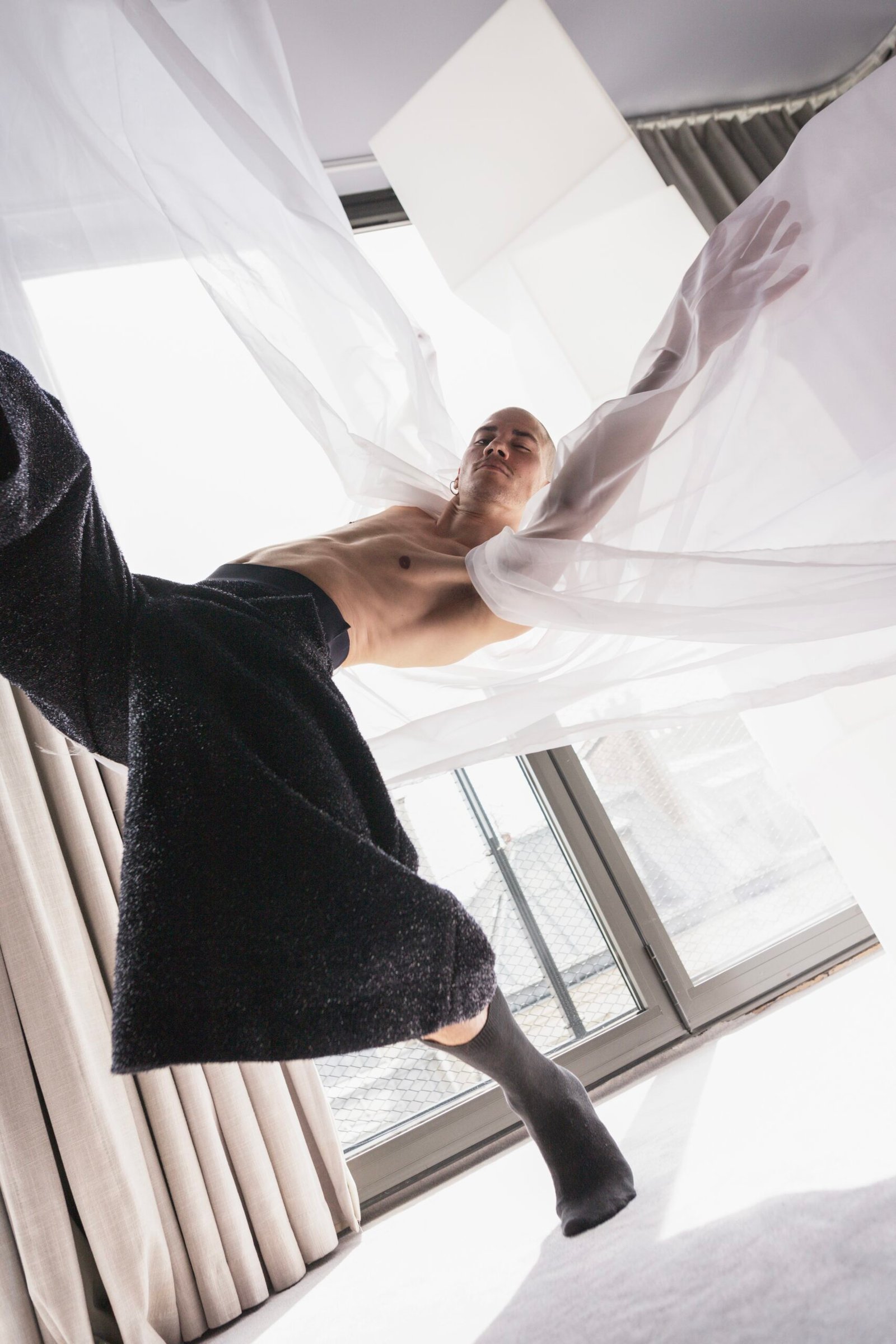
Dance workshop with Yohann Hebi Daher
26 November 2026 10:00 2h Amalgam Studio, Hamra

Date: 16 November 2026
Time: 20:30
Duration: 1 hour
Location: Al Madina Theater, Hamra

Performance by Selim Ben Safia
Labes, in Arabic, means “everything is fine.” In this piece for four dancers and a musician, choreographer Selim Ben Safia and conceptual artist Nadia Kaabi-Linke explore the antagonistic notions of standstill and resilience. To the sound of a viola da gamba, beyond ruins and denial, an ode to the dance of life.
Nadia Kaabi-Linke conceived the scenography based on her research into the Maghrebian Quarter of Jerusalem, destroyed in 1967. Evoking in its shadows the memory of this vanished neighborhood, the stage becomes a haunted space – a scene of dance and live music, as robust as it is luminous in its fragility. Transparent walls rise upon the stage like specters. This installation, shaped by notions of haunting and disappearance, fed into the choreographic approach and opened a poetic and political space. Carried by values powerful in their simplicity and commitment – the strength of vulnerability, the virtue of the collective, and art as a possible space for repair – Selim Ben Safia dares a true dance of joy.
On stage, five artists from different origins and aesthetic affinities – breakdance, circus, contemporary dance, traditional dance – become both performers and transmitters of this unwavering confidence in the founding benevolence of human connections. Traversed by the energy of Palestinian dakbé and traditional Tunisian rhythms, funeral chants and the universal accents of the viola da gamba, the bodies probe the tension between what freezes, buries itself or cements around us, and the vital impulse that continues to pulse within. A choreographic gesture of resilience.
About the artists
Choreography:
Selim Ben Safia began his training in hip-hop dance at the Sybel Ballet Théâtre, before advancing in contemporary dance at the National Choreographic Center in Montpellier. Since 2010, he has choreographed several works, exploring the complexity of artistic creation and the role of art in our societies. Passionate about inventing new gestures, Selim collaborates with diverse audiences, creating pieces for amateur dancers, actors, and people with disabilities. His projects have been presented at numerous international festivals, such as Rideau in Quebec, Trajectoire in Nantes, the Masa in Abidjan, Afrovibes in Amsterdam, and the Hammamet Festival in Tunis. In 2017, he founded the association “Al Badil – The Cultural Alternative,” with the mission of democratizing access to art and culture, promoting emerging artists, and supporting Tunisian cultural entrepreneurs. In 2022, Selim Ben Safia was appointed director of the Carthage Choreographic Days, the only national festival dedicated to dance in Tunisia.
Scenography:
Nadia Kaabi-Linke, born in 1978 in Tunis, is a Tunisian artist based in Berlin, best known for her conceptual art and her 2011 sculpture titled Flying Carpets (Fliegende Teppiche). `
Her work explores themes of geopolitics, immigration, and transnational identities. She won the Abraaj Group Art Prize in 2011 with the installation of Flying Carpets. The piece was acquired by the Solomon R. Guggenheim Museum in 2016. She also won the Discovery Prize for Emerging Art at Art Basel Hong Kong in 2014.
Some of her works have been acquired by the Museum of Modern Art, the Dallas Museum of Art, and the Samdani Foundation, and have been presented in several solo and group exhibitions.
Music:

Marie-Suzanne de Loye collaborates with artists from diverse backgrounds and is committed to exploring the many possibilities of her instrument, the viola da gamba.
Marie-Suzanne de Loye explores various aesthetics. She has performed for contemporary composers such as Lionel Ginoux, Jean-Pierre Seyvos (S-Composition), and Zad Moultaka; with Animal K (a trio alongside performer Violaine Lochu and electric guitarist Serge Teyssot-Gay). With the ensemble Chakâm, her work intertwines with Persian and Arab-inspired creations alongside târ player Sogol Mirzaei and qanun player Christine Zayed. She joins the Iranian music quintet Atine and occasionally performs with saz player Rusan Filiztek.
Dancers:

Mohamed Issaoui, also known as Françoise, is a Tunisian performer specializing in traditional Arab dances. Now settled in Paris to live “a freer life,” Mohamed is a major source of inspiration for this creation. His work is deeply rooted in tradition while also being imbued with his personal quest for freedom and expression.
Malek Zouaidi is a 43-year-old Tunisian-Togolese contemporary dancer and circus artist. Having worked between Tunis, Bamako, and Lomé, she brings to the piece a rich and diverse perspective, both from her circus practice and her African view of the contemporary world. Her stage experience in various contexts adds unique depth to the creation.
Ilyes Triki is a Tunisian dancer with a unique path bridging breakdance and ballet, after starting with the Urban Bboys Crew, he joined the Ballet of the Tunis Opera in my latest creation, El Botinière. His dance, a subtle blend of jazz and theatrical performance, 2018, performing in both classical and contemporary productions. As co-founder of embodies an artistic hybridity that enriches the choreographic language of this new piece. Mouvma Dance, he develops a distinctive choreographic language shaped by his background as a b-boy and mechanical engineer.
Romane Piffaut Dahkan is a choreographer and performer based between France and Morocco. Founder of the TURBA collective in Tangiers, she pays particular attention to mixing artistic practices, multiplying collaborations and forms of creation.

